Showing posts with label Areito. Show all posts

Friday, May 16, 2008

The Miami News, August 6, 1976, "FBI Informer Ties 2 to Firebombing" by Hilda Inclan.

FBI informant Miguel Angel Peraza has told authorities that two of the three men standing trial for attempting to bomb a Little Havana adult bookstore, threw firebombs into the home of an Areito magazine staffer almost three weeks before they were arrested at the bookstore on May 6.

One of the two, Antonio Rafael de la Cova, 25, already faces charges for the attempted firebombing at the home of Vicente Dopico as well as for the attempted bombing of the apartment of Eliseo Perez-Stable, another staffer of Areito, regarded as a pro-Castro magazine by some exiles here.

But Peraza, 34, said in a sworn deposition Wednesday night that both de la Cova and Blas Jesus Corbo, 20, threw the firebombs into Dopico's house on April 17. None of the firebombs nor the pipe bomb planted outside Perez-Stable's apartment went off.

Peraza, who was working for the FBI as a confidential informant on April 17, said he remained in a car outside Dopico's house while de la Cova and Corbo left with the firebombs and returned empty-handed minutes later.

According to Peraza, de la Cova later returned to the scene in his motorcycle out of curiosity to find out whether police had come out to check the bombs.

Peraza, who is due to testify this morning, said in his deposition de la Cova masterminded the attempted bombing of the bookstore. He also said de la Cova, Corbo and Gary Latham, the third defendant, had also considered bombing a synagogue in Fort Lauderdale and had planned another bombing (he did not mention the site) for May 20, Cuba's Independence Day.

(Latham, in his second turnabout in the trial, yesterday agreed to testify against his co-defendants.)

Peraza said de la Cova introduced him to Corbo in April.

Peraza, who has been accused of fomenting the bookstore crime by de la Cova's attorney, Mel Black, denied prodding the three arrested men to commit crimes.

"I let them think I was following them," he said. "I let them think I was a terrorist. I couldn't let them think I was a priest either."

De la Cova, a history buff who collected data on ati-Castro organizations and police officers alike, bought a pipe in a Lindsley Lumber store in Fort Lauderdale with $5 he borrowed from Peraza sometime in April, the informant said.

He added that he saw de la Cova making the pipe bomb later droppped in front of the bookstore. He said de la Cova assembled the device May 5 inside Latham's Boca Raton apartment under Latham's supervision.

Peraza said he couldn't find out where the trio had obtained the explosives used to manufacture the bomb or those stored in the apartment.

De la Cova, 25, in turn, is expected to testify that Peraza planned the entire bookstore operation and furnished the explosives. Black has been basing his client's defense on FBI entrapment.

FBI Agent George Kiszynski testified yesterday that Peraza's reliability had been tested against other informants. He said Peraza, who had been employed by a Spanish-language newspaper and later by a magazine, had been cooperating with the FBI as a volunteer since 1973, furnishing information on Castro-Communist infiltration in Miami and had never sought or received any payment.

But, Kiszynski added, he paid Peraza a total of $3,900 in expenses so far this year.

Latham, 22, spent a good deal of time last night giving a sworn deposition on the bookstore incident to the prosecutors, Assistant State Attorneys George Yoss and Hank Adorno.

Latham yesterday agreed to testify against his co-defendants if the state asked him. It was his second turnabout in plea-bargaining negotiations with the state. He pleaded no contest to five of six charges which, in all, carry a maximum sentence of 35 years.

In return, the state dropped one charge against him for possession of explosives with intent to harm, carrying with it a maximum sentence of 15 years. The agreement also stipulated that the state sentence was to run concurrently with whatever federal sentence is handed down. All three defendants face similar federal charges on Aug. 31.

Latham had already pleaded guilty in federal court in exchange for a maximum concurrent sentence of 12 years.

Had he stood firm on the first guilty plea he entered before Circuit Court Judge Ellen Morphonios Wednesday, he would have spared himself a possible 15 years in jail.

At that time, the state was willing to drop another charge against him for placing an explosive device with intent to harm, which carried with it a maximum 15-year sentence.

The reason the state was less willing to drop that charge yesterday was that Latham was not needed as badly as a witness.

"Yesterday he had a lot more to give us before we gave immunity to Peraza and obtained his deposition," Yoss explained.

Latham withdrew his first guilty plea when he realized that his friend, de la Cova, was not going to enter a similar plea - a situation which would have forced Latham to testify against de la Cova.

Latham's mother, father and two sisters talked to him briefly yesterday and apparently persuaded him to negotiate again. De la Cova was visibly angered by the move, while Corbo remained aloof.

Judge Morphonios asked Latham yesterday if he fully understood the terms of his plea and warned him that he could get the maximum sentenced on the five charges - 35 years - and probably would.

He said he understood.

Copyright (c) 1976 The Miami News

Sunday, April 27, 2008

The Miami News, May 7, 1976, "How Law Officers Tracked Suspects" by Louis Salome.

A red motorcycle, a dog-eared 15-month-old FBI memo and two bungled bombing attempts led police to make their first arrests in connection with a wave of terrorist bombings that began here two years ago.

A leader in the combined federal and local investigation was FBI agent George R. Kiszynski, a bomb expert. His principal quarry was a 25-year-old former history teacher, Antonio Raphael de la Cova of 960 Le Jeune Rd., who police said had a talent for planting bombs.

Kiszynski eventually pieced together the puzzle which led police in April to implement a seven-week, round-the-clock surveillance of de la Cova.

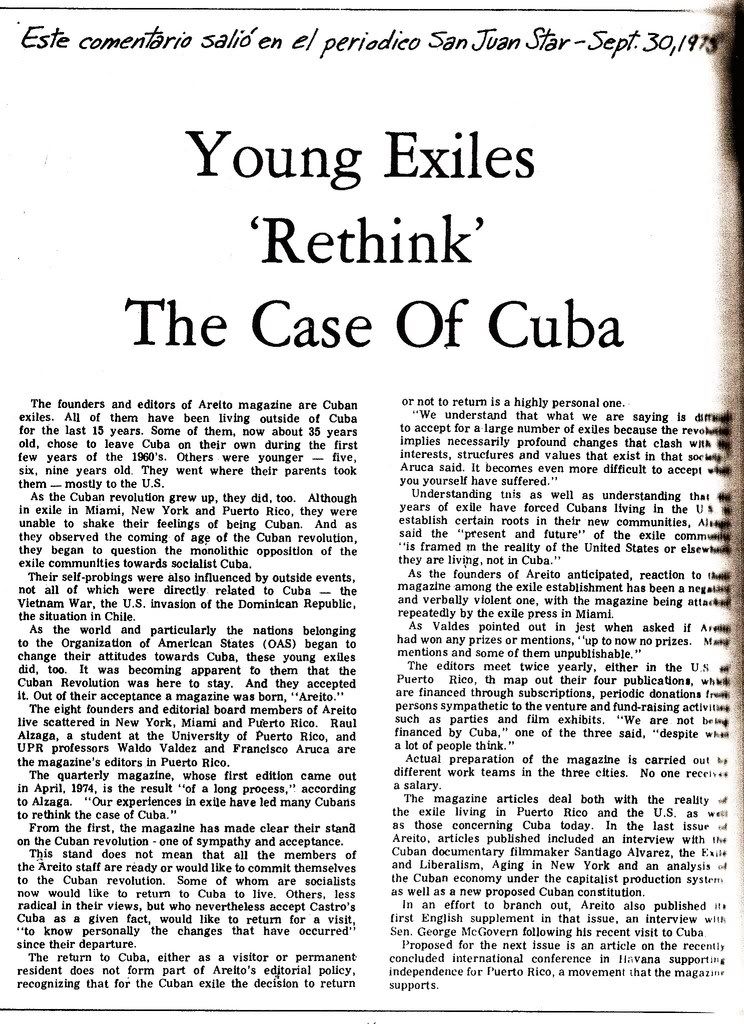
The hunt started last Nov. 18, when Kiszynski was called in to examine an unexploded pipe bomb left at the front screen door of a University of Miami dormitory apartment. Its occupant, Eliseo Perez-Stable was a staff member of Areito, a Spanish-language magazine which favored peaceful coexistence with Fidel Castro.

While checking out Areito - a national magazine with headquarters in New York and bureaus in several states - Kiszynski learned the name of Vicente Dopico, a member of its editorial board.

Almost four months later, Kiszynski was called in to investigate the attempted fire-bombing of Dopico's home at 450 NW 43rd Place.

As Kiszynski was cruising the area near the Dopico home, he saw a man riding a red motorcycle. Kiszynski followed the motorcycle south on Le Jeune Road and managed to force the rider to the side of the road.

"The rider was a white male, young, about mid-20s, Latin, wearing metal rim aviator glasses and dark clothing" - but as he got out of his car to question the rider, the man took off, fleeing through the yards of two homes.

Kiszynski had gotten a good look at Antonio Raphael de la Cova, but it took some digging and some luck for him to match the name to the face.

With the visual evidence in his head, Kiszynski returned to FBI headquarters here and found a memo written by Agent Joseph S. Dawson dated Jan. 10, 1975, 15 months earlier.

That memo said de la Cova, then a student at Florida Atlantic University, living at 311 SW 31st Ave., Fort Lauderdale, reported to the FBI that he had been accused by police in Boca Raton of stealing documents belonging to one of the officers of Areito. The memo related how de la Cova explained that some students at Florida Atlantic University favored the Castro regime.

To penetrate the magazine's hierarchy and learn more, de la Cova told Dawson, he had become friendly with some of Areito's leaders. But he denied stealing documents and offered to take a lie detector test, according to Dawson's memo.

Kiszynski tracked down a picture of de la Cova and now he had the identity of the man on the red motorcycle he had flagged down a few weeks earlier.

From that time in mid-April, a dragnet of police kept watch on de la Cova's every move. It paid off at 1:30 a.m. yesterday.

Police got the break they wanted Wednesday when a Metro investigation spotted de la Cova "reconnoitering" the 3400 block of SW 8th Street.

That investigator, David S. Nye, recalled that some Cubans had picketed the Mini-Adult Books store at 3458 SW 8th St. a couple of weeks earlier.

The police watch continued that same day and detectives saw de la Cova leave his apartment at 8 p.m. in a faded beige Volkswagen with a sunroof, heading north.

Other detectives saw an old school chum of de la Cova's, Gary E. Latham, leave his home at 1721 NW 15th Vista, Boca Raton, about 7:20 p.m. driving a 1974 Pinto.

At 9:16 p.m., two persons, one of them de la Cova, entered Latham's apartment. The other man was unidentified at the time. Shortly after, Latham returned home and at 9:37 p.m. the trio left in Latham's Pinto.

About 11:10 p.m., the three man returned to Latham's apartment and de la Cova was carrying "what appeared to be a heavy satchel or suitcase," FBI Agent Federico Villalobos said.

Shortly after midnight, the three men headed down Interstate 95 towards Dade County. The brown, three-door Pinto eventually stopped in the 3400 block of SW 8th Street.

Police said de la Cova, carrying a package, and another unidentified white male left the car and walked up 34th Avenue and turned up toward the adult bookstore.

When police moved in to arrest the pair, de la Cova tried to flee, dropping the package.

At this point, a small mystery creeps into the police account: There is no further mention of de la Cova's companion on the street. It is unclear how he escaped and police have refused to comment on the point.

After the arrest of de la Cova, other officers "almost simultaneously" moved in on the Pinto and arrested Latham and a man identified as Blas Jesus Corbo, address unknown.

That makes three men. However, if the police affidavit is accurate, there were four men on the scene - two in the car and two, including de la Cova, on the street.

Another mystery is Corbo himself. Police at first said his address was 660 Collins Ave. Miami Beach. But, the manager of the apartment at the address had no record of Corbo living in the building and other tenants said they had never heard of him.

Much more is known about Latham, who had been chums with de la Cova since elementary school.

When police searched Latham's home in Boca Raton, they found a shotgun, hand grenade, gelatin-type explosives and completed pipe bombs. Police called it a "bomb factory."

There were also reports from police that other parts of the dynamite allegedly planned for use at the adult bookstore were found in Latham's home.

An honor student in physics at FAU, Latham was regarded as virtually a hermit by his neighbors.

"This doesn't sound like the one I know," said Eve Magnuson, a neighbor. "We thought he was a hermit. He never had any visitors. He doesn't know anyone. You hardly knew he was there."

In his apartment, police found several books and publications on bombs, including one on how to defuse bombs by Metro's detonations expert Tom Brodie, who defused the explosive allegedly dropped on 8th Street by de la Cova yesterday morning.

The three men were charged with violating a series of state and federal laws. They are being held in Broward County Jail on $200,000 bond each.

Police have indicated that the arrests may lead to a breakthrough in solving other bombings that have been occurring in the Miami area with increasing frequency in the past two years. Since Jan. 1, 1975, there have been 80 of them attempted, 47 of which resulted in actual detonations.

Police hinted in the affidavits seeking warrants to search the apartments of de la Cova and Latham that the latter may have been involved in a series of five bombings last Dec. 3. But they stopped short of making a direct connection.

The state of terror that has gripped parts of Miami's Cuban community was shown by an incident yesterday afternoon at WQBA, a Spanish-language radio station whose news director, Emilio Milian, had his legs blown off by a bomb last Friday.

A WQBA spokesman said a suspicious-looking package addressed to Milian arrived in the mail. It had no return address.

Station officials promptly evacuated the building and called Metro's bomb squad. The bomb squad arrived and gingerly opened the 10-by-12 inch package.

It contained a Bible.
The Miami News, May 7, 1976, "De la Cova: Two Political Faces... A Fixation on Communism" by Hilda Inclan.

Antonio Raphael de la Cova, whom police arrested early yesterday as he was allegedly about to plant a bomb in an adult bookstore in Little Havana, is a man with two faces, politically and intellectually.

At Florida Atlantic University, where he received his bachelor's degree in history, he was known as a leader among pro-Castro intellectuals, police said.

It's likely he adopted a pro-Castro position at the university in order to infiltrate pro-Castro factions.

In Dade county, where de la Cova taught American history at a private high school, he was widely known as a vehement opponent of Castro.

His alleged attacks on Areito magazine, a national publication which advocated peaceful coexistence with Castro, mesh more with the Dade County version of his political leanings.

De la Cova's grades at FAU were good, and he has been seeking admission to the University of Miami's graduate school.

He was dismissed from his job as an eighth-grade history teacher at the Inter-American Military School at NW 7th Street and 36th Avenue in January because he could not maintain discipline in class.

"But he was a fine teacher," said school principal Pedro Roig.

"His fixation was Communism. He would always be very quiet until somebody brought up the subject of Cuba or Communism. Then, he wouldn't stop talking."

De la Cova, one of four children, had moved in the past year to an apartment at 960 Le Jeune Rd. It was from there that police had watched his every move for seven weeks.

Nancy de la Cova, his mother, said, "What can I tell you about him? I am his mother. If it is true that he was involved, then I can't condone it. I can't justify it. I must condemn this type of activity."

Mrs. de la Cova, who teaches Spanish in a private school during the day in Fort Lauderdale and in an adult education program at night, said, "If he had been stupid, I could understand that he would get involved in something like this. But he was very intelligent."

Rene de la Cova, Antonio father, is a lab technician at the North Broward General Hospital at Pompano.

His family has lived in Fort Lauderdale since July 1966. The family arrived from Cuba in 1961, and moved to Louisville and St. Louis before moving to South Florida.

De la Cova wrote sporadically for the weekly Spanish tabloid Libertad, which was directed by the late Rolando Masferrer, who was victim of a bomb blast last Oct. 31.

Masferrer's politics were mixed and he had many enemies on the right and left.

"This (de la Cova's arrest) has taken everybody by surprise," said Lucilla Masferrer, Masferrer's widow.

"He (de la Cova) was the type of person you would never suspect of terroristic activities. He looked rather harmless, kind of intellectual, a studious type of person."

Copyright (c) 1976 The Miami News