Showing posts with label Terrorism. Show all posts

Friday, May 16, 2008

The Miami News, August 6, 1976, "FBI Informer Ties 2 to Firebombing" by Hilda Inclan.

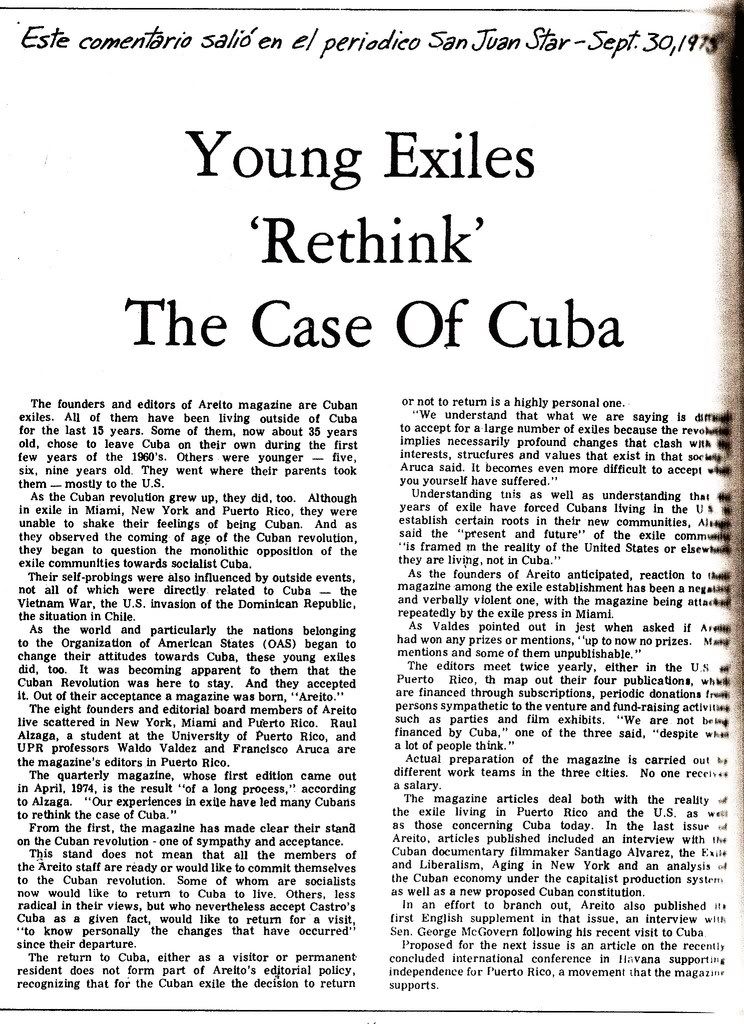
FBI informant Miguel Angel Peraza has told authorities that two of the three men standing trial for attempting to bomb a Little Havana adult bookstore, threw firebombs into the home of an Areito magazine staffer almost three weeks before they were arrested at the bookstore on May 6.

One of the two, Antonio Rafael de la Cova, 25, already faces charges for the attempted firebombing at the home of Vicente Dopico as well as for the attempted bombing of the apartment of Eliseo Perez-Stable, another staffer of Areito, regarded as a pro-Castro magazine by some exiles here.

But Peraza, 34, said in a sworn deposition Wednesday night that both de la Cova and Blas Jesus Corbo, 20, threw the firebombs into Dopico's house on April 17. None of the firebombs nor the pipe bomb planted outside Perez-Stable's apartment went off.

Peraza, who was working for the FBI as a confidential informant on April 17, said he remained in a car outside Dopico's house while de la Cova and Corbo left with the firebombs and returned empty-handed minutes later.

According to Peraza, de la Cova later returned to the scene in his motorcycle out of curiosity to find out whether police had come out to check the bombs.

Peraza, who is due to testify this morning, said in his deposition de la Cova masterminded the attempted bombing of the bookstore. He also said de la Cova, Corbo and Gary Latham, the third defendant, had also considered bombing a synagogue in Fort Lauderdale and had planned another bombing (he did not mention the site) for May 20, Cuba's Independence Day.

(Latham, in his second turnabout in the trial, yesterday agreed to testify against his co-defendants.)

Peraza said de la Cova introduced him to Corbo in April.

Peraza, who has been accused of fomenting the bookstore crime by de la Cova's attorney, Mel Black, denied prodding the three arrested men to commit crimes.

"I let them think I was following them," he said. "I let them think I was a terrorist. I couldn't let them think I was a priest either."

De la Cova, a history buff who collected data on ati-Castro organizations and police officers alike, bought a pipe in a Lindsley Lumber store in Fort Lauderdale with $5 he borrowed from Peraza sometime in April, the informant said.

He added that he saw de la Cova making the pipe bomb later droppped in front of the bookstore. He said de la Cova assembled the device May 5 inside Latham's Boca Raton apartment under Latham's supervision.

Peraza said he couldn't find out where the trio had obtained the explosives used to manufacture the bomb or those stored in the apartment.

De la Cova, 25, in turn, is expected to testify that Peraza planned the entire bookstore operation and furnished the explosives. Black has been basing his client's defense on FBI entrapment.

FBI Agent George Kiszynski testified yesterday that Peraza's reliability had been tested against other informants. He said Peraza, who had been employed by a Spanish-language newspaper and later by a magazine, had been cooperating with the FBI as a volunteer since 1973, furnishing information on Castro-Communist infiltration in Miami and had never sought or received any payment.

But, Kiszynski added, he paid Peraza a total of $3,900 in expenses so far this year.

Latham, 22, spent a good deal of time last night giving a sworn deposition on the bookstore incident to the prosecutors, Assistant State Attorneys George Yoss and Hank Adorno.

Latham yesterday agreed to testify against his co-defendants if the state asked him. It was his second turnabout in plea-bargaining negotiations with the state. He pleaded no contest to five of six charges which, in all, carry a maximum sentence of 35 years.

In return, the state dropped one charge against him for possession of explosives with intent to harm, carrying with it a maximum sentence of 15 years. The agreement also stipulated that the state sentence was to run concurrently with whatever federal sentence is handed down. All three defendants face similar federal charges on Aug. 31.

Latham had already pleaded guilty in federal court in exchange for a maximum concurrent sentence of 12 years.

Had he stood firm on the first guilty plea he entered before Circuit Court Judge Ellen Morphonios Wednesday, he would have spared himself a possible 15 years in jail.

At that time, the state was willing to drop another charge against him for placing an explosive device with intent to harm, which carried with it a maximum 15-year sentence.

The reason the state was less willing to drop that charge yesterday was that Latham was not needed as badly as a witness.

"Yesterday he had a lot more to give us before we gave immunity to Peraza and obtained his deposition," Yoss explained.

Latham withdrew his first guilty plea when he realized that his friend, de la Cova, was not going to enter a similar plea - a situation which would have forced Latham to testify against de la Cova.

Latham's mother, father and two sisters talked to him briefly yesterday and apparently persuaded him to negotiate again. De la Cova was visibly angered by the move, while Corbo remained aloof.

Judge Morphonios asked Latham yesterday if he fully understood the terms of his plea and warned him that he could get the maximum sentenced on the five charges - 35 years - and probably would.

He said he understood.

Copyright (c) 1976 The Miami News

Sunday, April 27, 2008

The Miami News, May 7, 1976, Editorial "Break, At Last, in Terrorism."

Everyone will hope that the arrests yesterday morning on SW 8th Street provide a genuine break in the wave of murders and bombings that have terrorized this community for the past two years.

In a display of excellent coordination, officers from the FBI and the county's two largest police departments, Miami and Dade County, apprehended three suspects, allegedly on the scene of an attempted bombing. One of the suspects was said to have been carrying an explosive device when the officers closed in.

The arrests obviously resulted from excellent intelligence work over a long period of time. The incident answers, at least in part, criticism that law enforcement agencies were giving the terrorism less attention than it deserved because the victims were Latins.

Common sense tells us that it is early, however, to conclude that the entire wave of terror, which has included scores of bombings, four murders and three murder attempts, will be closed because of these arrests.

Circumstances suggest that the terrorism in its different forms resulted from many possible motives. Certain covert political groups claimed responsibility for a few activities which appeared to be protest oriented, although even those were clouded by speculation that they were inspired by Castro partisans to sow confusion and discord.

Some of the incidents carried undertones of narcotic involvement, and still others were rumored to be simple cases of extortion - the old fashioned American protection racket.

Investigators believe the arrest of the three suspects, who seemed to be deeply involved in the manufacture of explosives, will lead to the apprehension of other persons connected to the terrorism. We hope they are correct.

We also hope that the investigating agencies will provide more information about all this as soon as possible. The break had been a long time coming; the public deserves relief from the anxiety that has hung over the community for the past two years.

Copyright (c) 1976 The Miami News

Saturday, April 12, 2008

The Miami Herald, May 6, 1976, Letter to the Editor "For 'Liberty'... Terrorism?"

It is almost impossible to comprehend how the minds of these bomb throwers and planters work.

For "Liberty" they try to destroy someone?

For "Liberty" they attempt to silence by hideous means those in the community who disagree with them?

For "Freedom" they would run the risk of crippling or maiming or murdering innocent individuals?

How little sensitivity they must possess. How small a portion of them must be given over to the decisions of right or wrong.

I am sickened and revolted by revolutionaries who try to impose the greatest tyranny of all on our community; the utter disregard and lack of respect for the sanctity of human life.

I sincerely hope that none for a minute think that their activities reflect in any way on the 99.99 per cent of our Latin community that has given us so much and abides with and loves the law.

MICHEAL J. O'DONOVAN

Copyright (c) 1976 The Miami Herald
The Miami News, May 3, 1976, Editorial "An Excuse for Inaction."

When somebody knocks off a couple of banks in town, the police usually do not wait for the English-speaking community to decide to turn in the robbers. Instead, the various city, county, state and federal police agencies dig in to try to track down the lawless gang of toughs.

That is the same attitude with which law enforcement people should approach the detestable murders and attempts at murder that have become epidemic within Miami's Cuban exile community. It is ridiculous to suppose, as some police officials apparently do, that the identity of the bombers is common knowledge among the generally law abiding half-million Dade residents of Cuban origins. The criminals are killers, and they will have to be tracked down like other killers.

There is a not-so-subtle racism in the implication that four murders, dozens of bombings and several attempts at killings are somehow a Cuban problem for which all local Cubans share the responsibility.

The explosion Friday night which nearly killed WQBA newscaster Emilio Milian was not an act of the Cuban community - it was a vicious act by criminals who deserve at least as much attention as police gave to Patty Hearst. It is an insult to Dade's thousands of Cubans to imply that they do not want to see the terrorists brought to justice.

Milian's employer is offering a $25,000 reward for information on his assailants and many leading local Latins have deplored the violence that terrorizes their neighborhoods. It is time for the police, and especially the federal agencies, to stop blaming their own failures on some alleged conspiracy of silence.

There is good reason to believe that at least some of the bombings and killings are connected to each other, and that they may relate either to political activity or to organized extortion. In either case, there is justification for the FBI to bring its full weight into the matter as Miami Mayor Maurice Ferre requested last year.

The terrorism which makes Dade the nation's leading center of such activity is not a Cuban problem, it is a Miami problem, and it is past time for the police to throw their fullest possible resources into the fight.

Copyright (c) 1976 The Miami News
Tuesday, April 8, 2008

The Miami Herald, May 1, 1976, "Cuban Newsman is Maimed As Bomb Explodes in Car" by Edna Buchanan and Dorothy Gaiter.

A bomb planted under the hood of his station wagon shattered the legs of the news director of Spanish-language radio station WQBA in Little Havana Friday night.

Emilio Milian, 45, who had editorialized against terrorism and violence in Miami, stepped out of the station after a show, got into his WQBA car, turned on the ignition and the device detonated at 7:17 p.m.

Late Friday doctors at Jackson Memorial Hospital amputated both of Milian's legs below the knees, and at 2 a.m today he was still in surgery, the hospital said. His condition was described as "serious but stable."

Moments before the explosion, Milian had been approached in the parking lot by Rosa Delgado and three friends who found a little lost boy. Miss Delgado, who attends Garces Commercial College on the first floor of the concrete-block building that houses the radio station, had explained the little boy's plight to Milian and he told them the station would call the police.

Then he turned on the ignition. Miss Delgado and her friends were 10 feet away.

"There was dark smoke and flames. I tried to open the door but it was too hot. I told him to help me help him. His eyes were full of pain," Mis Delgado said.

"He kept shaking his hands. He didn't say anything. He was bloody all over. He pulled up his leg to show me he couldn't move. His leg appeared to be severed below the knee. He was just looking at me."

Albert Miguel, 20, who was passing when he saw the hood of Milian's car hurled 100 feet in the air, ran to help. With two of Garces students he tried to open the car door but it was jammed.

Milian, still conscious, asked them: "Get me out."

"I couldn't open the door so I grabbed him by the belt and by his leg. His leg, both his legs were gone," Miguel said.

He and the others lifted Milian from the car.

"He's a brave man,' said Professor Herbert Garcia of the college. "He didn't cry. He saw his legs, but he didn't cry. He was trying yo get up."

Garcia said Milian pounded the pavement with his fists in anger and agony.

"He's one of the best," Garcia said of the broadcaster, whose station has the largest audience of any station in the metropolitan area. "He's a leader against Fidel Castro and leftists. Of course that's why this happened."

Miami City Commissioner J.L. Plummer, nearby when the explosion rocked the neighborhood, arrived then and was credited by firemen with saving Milian's life.

Milian recognized Plummer at once, as the commissioner worked to stop the bleeding.

"I was afraid he would bleed to death. He said: 'Plummer, the pain is very bad. Do something for the pain.' I told him I was doing everything I could," Plummer said.

Homicide Detectives Anthony Dagger and Ina Shepard arrived minutes after the blast, while firemen, who were still working on Milian, put him into a "shock suit" that forces blood up into the vital organs, preventing the victim from lapsing into shock.

Detective Dagger said Milian had been the target of "many threats in the past months after his editorials against the terrorists here in town."

Police had a watch over Milian's home.

Maj. Phil Doherty said the bomber apparently planted the device under the station wagon's hood during the daylight hours in the WQBA parking lot. Milian had driven it home for lunch.

Milian, who was born Sept. 8, 1930 in Cuba's Las Villas Province, had come to this country in 1965. He opened a print shop and worked part-time as a sports commentator for the station that later would become WQBA. In 1971, he became news director. He also directed the station's programming.

At Jackson Memorial, Milian's wife Enma Mirta, two sons, a daughter, his elderly father and two sisters maintained vigil late Friday night as surgeons operated.

Milian's son, Alberto, 15, said the death threats his father received were all the same. "They told him to shut up, to stop criticizing the bombings or they would murder him. He felt it was his right to criticize. He took precautions. He was not afraid.

"He had a gun, but he never looked under his car," young Milian said. "He told us when his day came, it would come." His father, he said, was angry "at the stupid idiots who were bombing."

Two days ago, the family said, a white car passed their home, stopped in front and someone got out. Milian reported the suspicious vehicle and its occupants to police and asked for protection.

After the Milian bombing Friday, Miami fire officials investigated a fire that gutted the 45-foot commercial fishing boat El Brabo at the Merrill-Stevens Dry Dock on the Miami River at 12th Avenue. There was no immediate evidence that the fire resulted from a bomb or that it was connected to the Miami incident, they said.

Copyright (c) 1976 The Miami Herald